Product Description
Rare US Defense Research Lab Certified p-Type Zinc Antimonide (ZnSb) Single Crystal Cube – Research-Grade Thermoelectric Sample
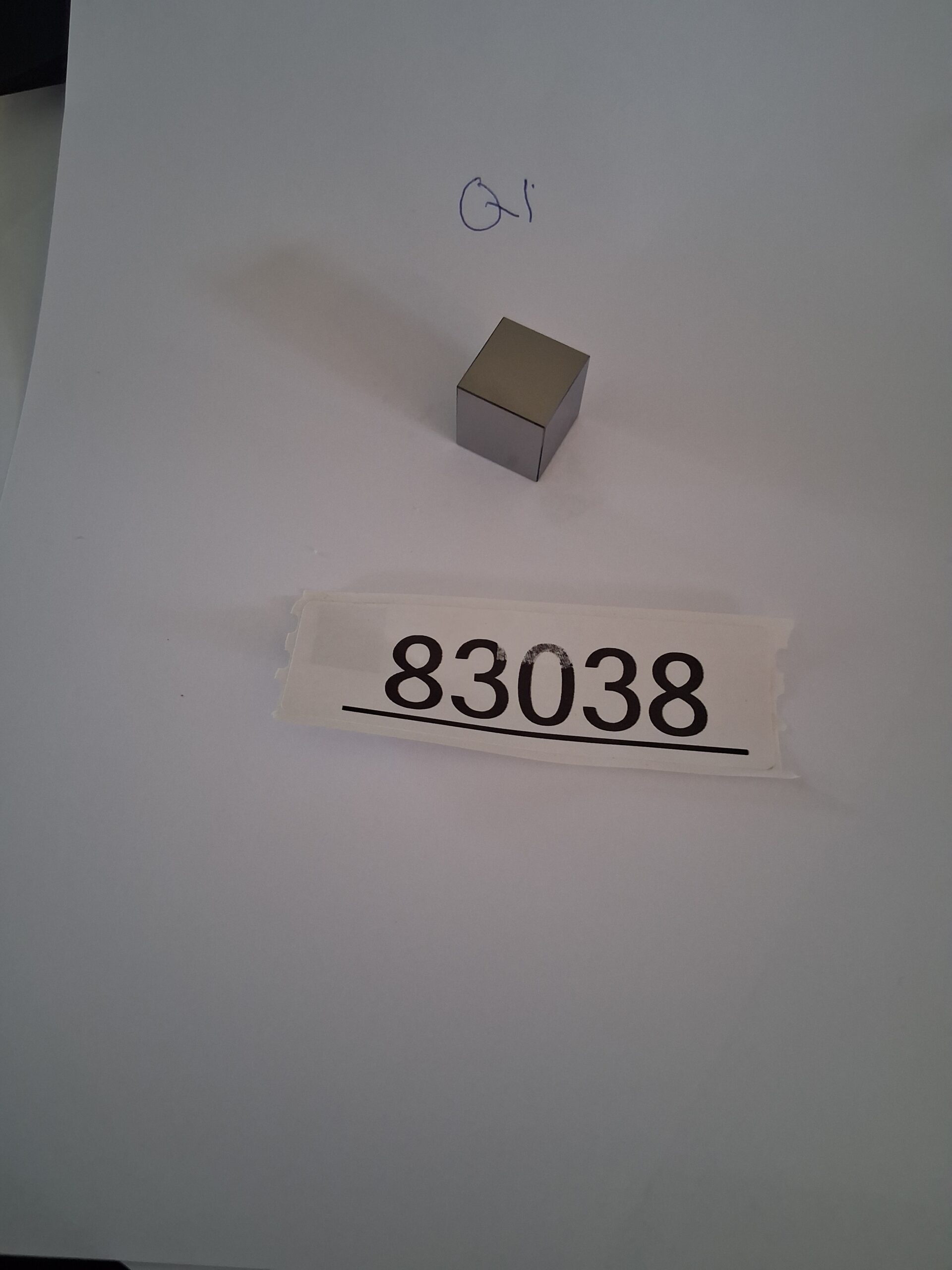
This is a premium, certified oriented single crystal cube of p-type zinc antimonide (ZnSb), produced by a leading US Defense Research Lab specializing in space optics and advanced technologies for national security. This cube measures approximately 0.75 inches (19 mm) on each side.
Zinc antimonide (ZnSb) is an inorganic chemical compound and a semiconducting intermetallic material used in transistors, infrared detectors, thermal imagers, and magnetoresistive devices . Its thermoelectric properties have been studied since the 1860s, with significant research conducted at MIT and other leading institutions throughout the 1960s .
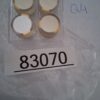
This cube features five optically polished faces for precise measurements and one unpolished face with etched orientation markings (A, B, C, D) and serial number for easy identification and handling. The cube comes with its original protective pouch labeled “9-4137” and barcode for traceability. Sourced from surplus inventory, it’s in excellent condition—clean, unmarked polished surfaces, and ready for immediate use in lab or collection settings. This artifact dates potentially to the 1970s era of groundbreaking thermoelectric research at US defense labs, making it a unique piece of scientific history.
Material and Properties
Zinc antimonide (ZnSb) crystallizes in the orthorhombic structure (space group Pbca, No. 61) . Key properties include:
| Property | Typical Value |
|---|---|
| Band Gap | 0.56 eV at room temperature |
| Crystal System | Orthorhombic |
| Density | 6.33 g/cm³ |
| Melting Point | 546°C |
| Seebeck Coefficient | High (100-200 μV/K typical for p-type) |
| Structure | Orthorhombic, oP16, Pbca, No. 61 |
As a p-type material, it exhibits:
-
High Seebeck coefficient (100-200 μV/K)
-
Moderate electrical conductivity
-
Low thermal conductivity, optimized for thermoelectric performance
-
Strong anisotropy in electrical conductivity and other transport properties
The material is high-purity (99.99%+ certified) semiconducting intermetallic compound with a gray metallic appearance and anisotropic properties ideal for direction-dependent testing.
Anisotropy & Orientation Significance
ZnSb single crystals exhibit significant anisotropy in their electrical and thermal properties, which is why oriented samples are essential for accurate research:
-
Electrical Conductivity Anisotropy: σc = 1.5σa = 2.5σb approximately
-
Mobility Ratios: The three principal mobilities are in the ratio μ[010]:μ[100]:μ[001]=1:2.6-2.9:4.1-4.5 at liquid nitrogen temperature
-
Thermal Conductivity: Slight (~12%) anisotropy measured
-
Hall Effect: Found to be isotropic
-
Seebeck Coefficient: Found to be isotropic
For thermoelectric applications, the highest figure of merit (Z) is obtained with thermal and electrical currents directed along the c-axis of the crystal . This makes orientation markings critical for proper experimental use.
The marked surfaces (A, B, C, D on four polished side faces) signify specific crystallographic orientations for direction-dependent testing of properties like electrical resistivity or thermal conductivity, while the fifth polished face (opposite the unpolished reference side) enables additional 3D measurements along perpendicular axes—enhancing experimental accuracy and reproducibility.
Key Specifications
| Specification | Details |
|---|---|
| Manufacturer | US Defense Research Laboratory |
| Material | High-purity p-type Zinc Antimonide (ZnSb) |
| Purity | 99.99%+ certified |
| Dimensions | ~0.75 inches (19 mm) cube |
| Polished Faces | 5 faces optically polished |
| Unpolished Face | 1 face with etched orientation markings (A, B, C, D) and serial number |
| Orientation | Principal crystallographic axes identified |
| Serial Number | Present (etched) |
| Original Packaging | Protective pouch labeled “9-4137” with barcode |
| Era | Circa 1970s (thermoelectric research heyday) |
| Condition | Excellent – no chips, scratches, or contamination |
Historical & Scientific Context
Zinc-antimony alloys have a rich history in thermoelectric research:
-
First reported use in the original work of Seebeck on thermoelectricity
-
Moses G. Farmer developed the first high-powered thermoelectric generator based on ZnSb, demonstrated at the 1867 Paris Exposition
-
Maria Telkes researched the material at Westinghouse during the 1930s
-
MIT conducted extensive single-crystal studies in the 1960s, including galvanomagnetic, thermoelectric, and thermal conductivity measurements
-
US defense labs pursued ZnSb research for space vehicle power systems and thermoelectric generators for nuclear batteries
This cube represents that legacy—a tangible artifact from the era when thermoelectric materials were being systematically characterized for space and defense applications.
Applications and Uses
Originally fabricated for studies on thermal and electronic transport properties (e.g., thermoelectric power and conductivity along principal crystal axes at various temperatures), this cube is perfect for:
Thermoelectric Research and Development:
-
Convert heat to electricity (Seebeck effect) or enable cooling (Peltier effect) in experiments, prototypes, or educational demos
-
Study of figure of merit (ZT) optimization through doping and nanostructuring
-
Investigation of phonon-glass electron-crystal (PGEC) behavior
Sensor and Detector Technologies:
-
Applications in infrared detectors, portable power sources, or thermal imaging systems
-
Aligns with defense, aerospace, and space optics needs
-
ZnSb is used in transistors, infrared detectors, thermal imagers, and magnetoresistive devices
Materials Science Education:
-
Ideal for university labs, STEM programs, or museums to demonstrate crystal orientation, anisotropy, and semiconductor behavior
-
Direct observation of anisotropic transport properties
Collectors and Hobbyists:
-
A rare surplus item from a US defense research portfolio
-
Suitable for scientific memorabilia or custom projects
-
Its oriented design allows precise measurements in anisotropic materials, making it valuable for R&D in renewable energy, electronics, quantum technologies, and space-based systems where reliability under extreme conditions is critical
Condition
EXCELLENT – PRISTINE
NO CHIPS, SCRATCHES, OR CONTAMINATION
FIVE POLISHED FACES: OPTICALLY CLEAN
ORIENTATION MARKINGS (A, B, C, D): CLEARLY ETCHED
SERIAL NUMBER: VISIBLE
STORED IN ORIGINAL PROTECTIVE POUCH
BARCODE AND “9-4137” LABEL INTACT
READY FOR IMMEDIATE USE
⚠ HANDLING NOTE: This is a precision single crystal for research use. Handle with clean gloves. Avoid thermal shock. Store in dry environment. ZnSb is a semiconductor material; avoid exposure to extreme temperatures or mechanical stress.
| Weight | 2 lbs |
|---|---|
| Dimensions | 6 × 6 × 6 in |
Related products


Laser Accessories