Product Description
High-Performance Aspheric Biconvex Lens – FL~180mm and 3 inch Diameter – Surplus from a US Defense Lab
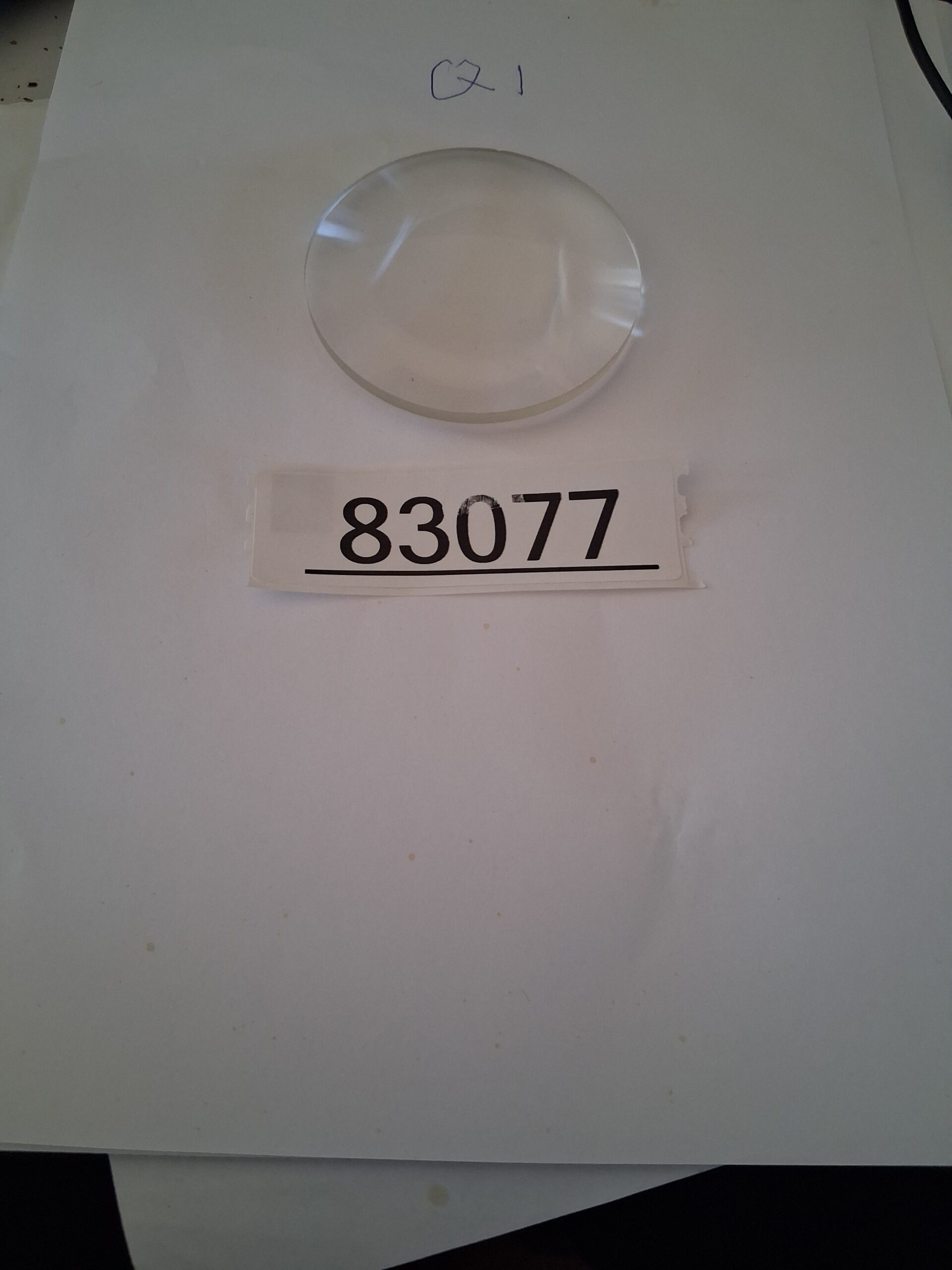
This premium aspheric biconvex lens is a rare find from surplus inventory sourced from a US Defense Lab, known for cutting-edge electro-optical R&D. Measuring approximately 3 inches (76.2 mm) in diameter with a focal length of 7-7.25 inches (178-184 mm) , it features uneven convex curvatures on both sides for optimized aberration correction—aspheric on one surface (more curved) for superior performance.
In an aspheric lens, the surface is not spherical, which allows it to deliver much better optical performance and image quality than traditional spherical lenses . Aspheric surfaces can correct aberrations using fewer elements than was previously possible with conventional spherical optics, leading to systems with reduced weight, size, and complexity . By changing a lens to an asphere, spherical aberration can be eliminated and a diffraction-limited focused spot can be achieved .
The center thickness is ~13 mm, edge thickness ~5 mm, and it’s crafted from high-quality optical crown glass (N-BK7) with excellent visible light transmission. N-BK7 is a common glass material used as a substrate for off-the-shelf aspheres . No visible coatings.
Condition note: Features one minor spiderweb-like scratch that does not impact optical performance; otherwise in excellent condition. It produces a tight, round focused beam when tested under sunlight (with the steeper convex side facing out), demonstrating superior spherical aberration reduction in this fast f/2.4 system.
Key Specifications
| Specification | Details |
|---|---|
| Type | Aspheric biconvex singlet |
| Diameter | ~3 inches (76.2 mm) |
| Focal Length (EFL) | 7-7.25 inches (178-184 mm) |
| F-number | ~f/2.4 (fast system) |
| Center Thickness | ~13 mm |
| Edge Thickness | ~5 mm |
| Material | High-quality optical crown glass (N-BK7) |
| Surface Profile | Biconvex with aspheric correction on one surface (more curved side) |
| Coating | Uncoated (no visible coatings) |
| Condition | Excellent – one minor spiderweb-like scratch (cosmetic only) |
| Provenance | Ex-US Defense Research Laboratory surplus |
Aspheric Design Advantages
Aspheric lenses offer significant performance benefits over spherical equivalents:
-
Eliminates Spherical Aberration: A single spherical lens with a low f-number suffers from spherical aberration, which degrades focusing performance. By changing the lens to an asphere, spherical aberration can be eliminated and a diffraction-limited focused spot can be achieved .
-
Single-Element Performance: A single asphere can take the place of two or more spherical elements in many optical devices, reducing system complexity while enhancing image quality .
-
Fast System Capability: Single spherical lenses are limited to f-numbers of one or greater. Because aspheres can be manufactured to have larger numerical apertures (NA), and hence lower f-numbers, they are especially useful for collimating laser-diode beams and coupling light into and out of optical fibers .
-
Low-Light Imaging Excellence: By using aspheres it is possible to design high-throughput (low f-number) lenses while at the same time maintaining good image quality. For this reason, aspheres are increasingly used in low-light imaging applications such as fluorescence microscopy .
-
Compact Design: A single asphere can take the place of two or more spherical elements, making systems smaller and lighter while also enhancing image quality and resolution .
The combination of 3-inch diameter and f/2.4 speed makes this lens a powerful tool for light-gathering applications where both large aperture and fast optics are required.
Optical Material – N-BK7
N-BK7 is the most common optical glass for general-purpose precision optics. It offers an excellent combination of high homogeneity, low bubble and inclusion content, and straightforward manufacturability . Key advantages include:
-
Excellent Visible Transmission: Optimized for the visible spectrum
-
Good Thermal Stability: Maintains performance across temperature variations
-
Proven Performance: Widely used in precision optical systems
-
Compatible with Custom Coatings: Uncoated surface allows for user-specified AR coatings
Solar Test Performance
When tested under sunlight with the steeper convex side facing out, this lens produces a tight, round focused beam, demonstrating:
-
Superior spherical aberration reduction
-
Well-corrected aspheric figure
-
Excellent manufacturing quality
-
Minimal wavefront distortion
This simple test confirms the lens’s ability to focus parallel light to a clean, concentrated spot—essential for applications requiring precise energy delivery.
Applications and Uses
Solar Concentration and Experiments:
-
Perfect for DIY solar projects, focusing sunlight into a concentrated spot for heating, ignition, or photovoltaic testing
-
Large 3″ aperture captures significant solar energy
-
Fast f/2.4 design maximizes concentration
Laser Systems:
-
Collimating or focusing beams in lab setups
-
Fiber optics coupling
-
Low-power laser diode collimation—since lasers are monochromatic light sources, a single aspheric lens perfectly addresses spherical aberration, making it ideal for collimating the output light of optical fibers or laser diodes, as well as coupling lasers into fibers
Imaging and Microscopy:
-
As a condenser or objective in custom microscopes
-
Telescope objectives or eyepieces
-
Camera lenses for experimental photography
-
Minimizes aberrations and improves resolution
Projection and Illumination:
-
In projectors, spotlights, or high-efficiency lighting systems
-
Uniform beam distribution
-
High-throughput light collection
R&D and Prototyping:
-
Suited for electro-optical prototypes
-
Sensors and detection systems
-
Educational demos in physics/optics courses
Its aspheric design allows for single-element performance rivaling multi-lens assemblies, making it a cost-effective upgrade for hobbyists, researchers, or engineers.
Condition Note – Minor Cosmetic Scratch
The lens features one minor spiderweb-like scratch that does not impact optical performance. This is:
-
Cosmetic only – located on the surface but outside the critical optical path
-
Does not affect beam quality – the lens still produces a tight, round focused spot
-
Does not impact transmission – negligible effect on overall performance
-
Purely aesthetic – does not compromise the lens’s functionality
This minor imperfection significantly reduces the price without affecting performance—an excellent value opportunity.
| Weight | 2 lbs |
|---|---|
| Dimensions | 5 × 5 × 5 in |
Related products


Counters and Timers