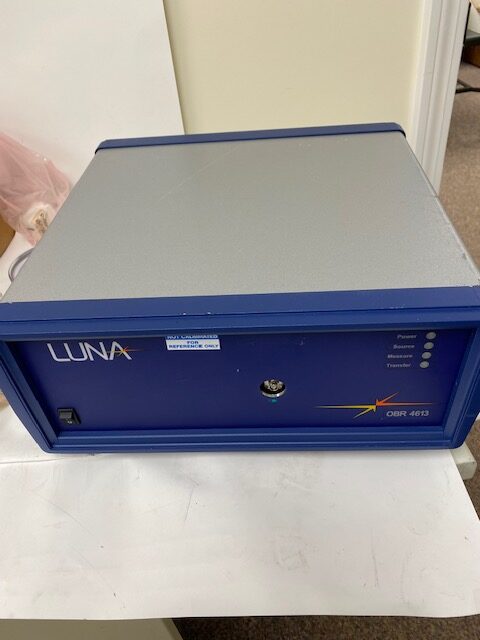
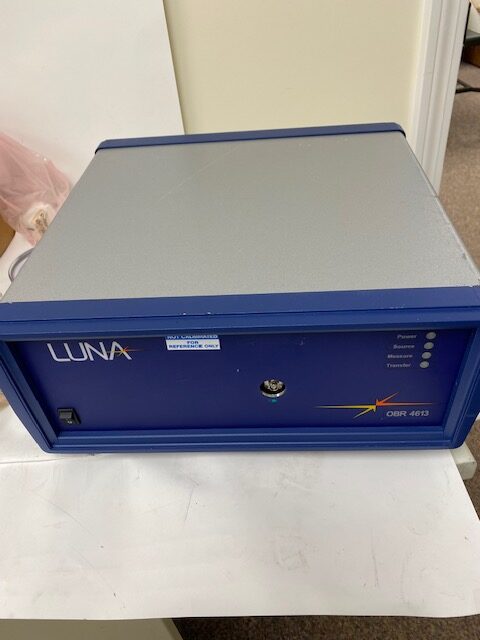
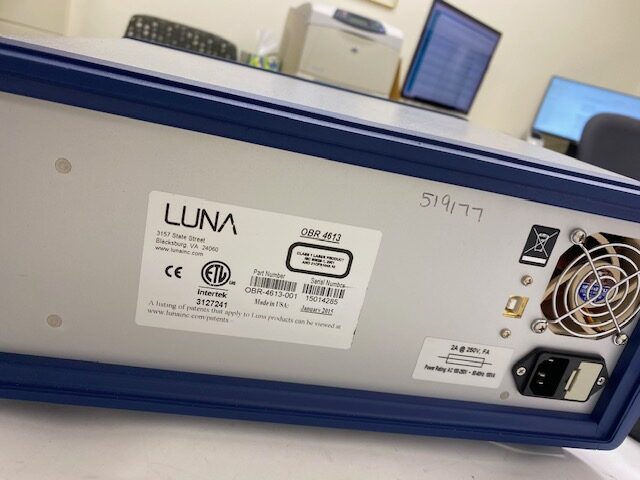
Luna Technologies OBR‑4613 Optical Backscatter Reflectometer
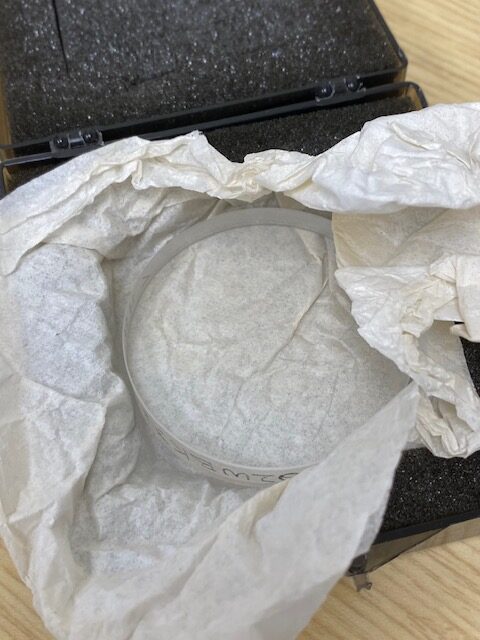
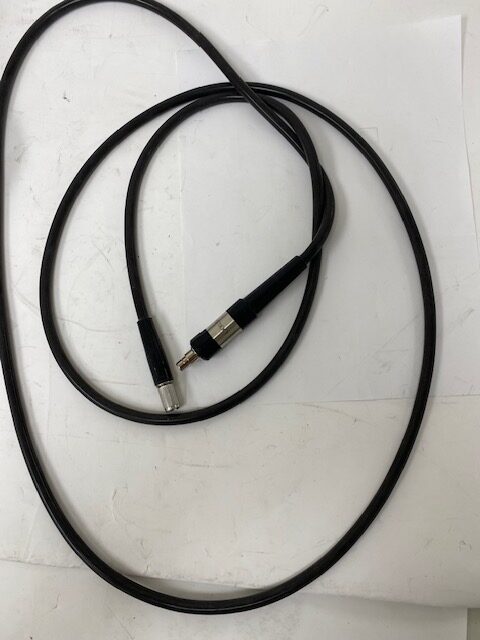
$44,600.00
1 in stock
Compare-
The OBR‑4613 is essentially a variant of the OBR‑4600 instrument designed for O‑band operation, covering wavelengths from 1270 nm to 1340 nm. It provides ultra-high spatial resolution reflectometry with zero dead zone, making it ideal for precise testing of optical components and short‑run fiber networks up to 2 km in length.
Key Technical Specs
-
Wavelength Range: 1270 nm – 1340 nm (O‑band)
-
Spatial Sampling Resolution:
-
10 µm (30 m mode)
-
20 µm (70 m mode)
-
1 mm in extended‑range mode (up to 2000 m)
-
-
Dynamic Range:
-
Return Loss (RL): up to 80 dB (standard modes), 60 dB in extended range
-
Insertion Loss (IL): up to 18 dB
-
-
Sensitivity: –130 dB backscatter‑level detection
-
Scan Capabilities:
-
Fast scanning (up to ~3 Hz spot‑scan mode)
-
Full scans (e.g. 30 m in ~2.5 s at wide spectral sweep)
-
-
Measurements Offered: Return loss, insertion loss, distributed loss, polarization states, phase derivative, group delay
✅ Applications
-
Diagnose losses or defects in short-run fiber networks or photonic integrated circuits (PICs)
-
Characterize individual features: couplers, splices, connectors, bends
-
Measure optical parameters like return loss, insertion loss, group delay
-
Perform high‑definition strain or temperature sensing using fiber as a distributed sensor
The Luna Technologies (Optical Backscatter Reflectometer) is used by various professionals in the fiber optic and related industries for testing, troubleshooting, and characterizing fiber optic components, networks, and assemblies. This includes applications in telecommunications, aerospace, defense, and manufacturing.
Specific users include:
- Telecommunications companies:
For testing and maintaining optical networks, diagnosing faults, and ensuring network performance.
- Aerospace and defense contractors:
For testing and monitoring fiber optic components in aircraft, satellites, and other critical systems.
- Manufacturers of fiber optic components:
For quality control and assurance in the production of fiber optic cables, connectors, and other components.
- Research and development labs:
For characterizing and developing new fiber optic technologies and devices.
- Data centers:
For maintaining high-speed, low-latency fiber optic links, particularly in hyperscale environments.
- Companies involved in structural health monitoring:
Using the OBR’s distributed sensing capabilities to monitor strain and temperature in structures like bridges and aircraft.
- Companies involved in process control:
Monitoring temperature and other parameters in industrial processes using fiber optic sensors.
Key capabilities of the OBR-4613 that make it attractive to these users include:
- High spatial resolution: Enables pinpointing faults and defects with micron-level precision.
- Long range and sensitivity: Allows for testing of long fiber optic links with high accuracy.
- Zero dead zone: Ensures accurate measurements even at connector locations or other points of interest.
- Distributed sensing capabilities: Enables continuous monitoring of strain and temperature along the fiber.
- Polarization control and measurement: Helps optimize performance in modern optical networks, especially in data centers.
- Intuitive software interface: Provides a user-friendly platform for measurements and analysis
| Weight | 30 lbs |
|---|---|
| Dimensions | 16 × 16 × 10 in |
Related products