Sale!
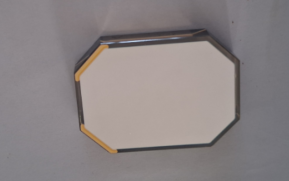
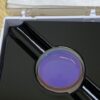
Rare High-reflectivity Protected Gold-Coated IR Mirror
Original price was: $750.00.$500.00Current price is: $500.00.
SKU: 82624
3 in stock
CompareKey Specifications
- Manufacturer/Coater: Barr Associates, Inc.
- Description: Protected gold-coated mirror witness sample for NFOV F2 (fold/secondary mirror in narrow field of view telescope assembly)
- Excellent durability and environmental resistance (space-qualified level).
- Substrate: Likely fused silica or low-expansion glass for thermal stability in space/defense applications.
- Coating: High value Protected gold (gold metallic layer + thin dielectric overcoat) with gold-coated handling tabs/flaps – high reflectivity >96–98% from ~800 nm (NIR) to 20 µm (mid/far-IR)
- Size: ~50 mm X 38 mm ~8 mm thick
- P/N 804717 NFOV F2
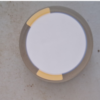
- Shape: Octagonal substrate with gold handling tabs/flaps
- Condition: Pristine surplus – clean reflective surface with characteristic white/opaque appearance under diffuse light, gold tabs for handling
Why This Mirror Is Special
As the “F2” witness in an NFOV assembly, it supported high-resolution, narrow-field imaging in Lincoln Lab’s defense telescope projects (e.g., space object tracking or laser systems). Barr’s dielectric stacks are durable and space-qualified.
Versatile Applications
- IR Laser Alignment & Experiments – Beam steering for CO2 (10.6 µm), Nd:YAG (1.064 µm), or diode lasers in NIR/IR labs. High reflectivity and durability make it great for lab setups.
- Thermal Imaging / IR Optics Projects – Reflector in DIY FLIR cameras, blackbody calibration, or heat detection prototypes – reflects thermal radiation efficiently.
- Astronomy & Space Optics Demos – Fold mirror in IR telescope builds or educational models of space surveillance systems.
- Spectroscopy & Scientific Instruments – High-IR mirror for FTIR, Raman or custom spectrometers.
- Artistic Light Installations – Golden reflections create stunning effects under different lights.
Performance Highlights
Dielectric HR coatings from Barr provide superior reflectivity (>99% in optimized bands), durability, and low absorption and high laser damage threshold compared to metallic mirrors – essential for narrow-FOV telescopes needing maximum light efficiency and minimal scatter.
| Weight | 1 lbs |
|---|---|
| Dimensions | 5 × 5 × 5 in |
Related products