

- +21 more
Product Description
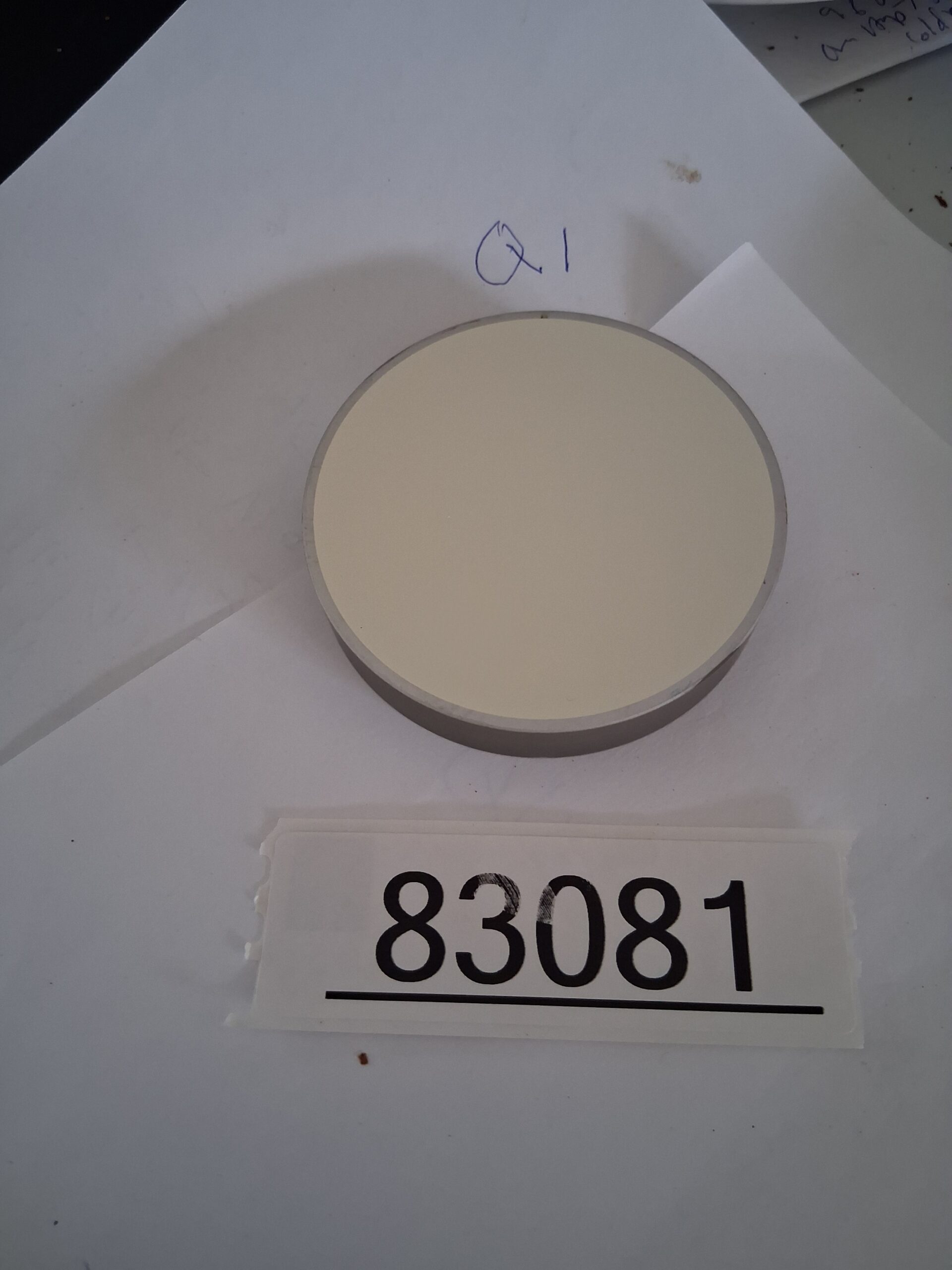
Surplus Parabolic Concave Mirror – 3.25″ Diameter, f/1.7, Defense Lab Origin
This is a high-quality first-surface parabolic concave mirror, sourced as surplus from a US Defense research laboratory. Ideal for precision optical applications, it features a transparent optical glass substrate with a polished plano back side and a front concave surface coated for superior reflectivity. The parabolic profile ensures minimal spherical aberration, making it suitable for focusing parallel rays to a sharp point—perfect for demanding setups where image clarity is critical.
A parabolic mirror, unlike a spherical one, does not exhibit spherical aberration and is essential for compact, fast (low f-number) reflecting telescopes . The production of a parabolic mirror is much more complicated than a spherical one, making this a precision component .
The polished rear side not only enhances thermal stability and stress relief but also enables advanced quality control, such as interferometric testing through the transparent substrate to verify the front curve’s accuracy and inspect the coating integrity from behind, ensuring no pinholes, defects, or inconsistencies in the reflective layer.
Key Specifications
| Specification | Details |
|---|---|
| Type | First-surface parabolic concave mirror |
| Diameter | Approximately 3.25 inches |
| Edge Thickness | 14 mm |
| Sagitta (Center Depth) | ~3 mm |
| Focal Length | ~5.6 inches (142 mm) |
| Focal Ratio (f/#) | ~1.7 (fast design for compact systems) |
| Surface Profile | Parabolic (inferred from sharp reflections and low aberration) |
| Substrate Material | BK7 borosilicate crown glass |
| Substrate Transmission | 330-2100 nm (visible spectrum) |
| Mirror Coating | Vacuum-deposited aluminum with protective SiO overcoat |
| Reflectivity | ~90-95% across visible and near-IR wavelengths |
| Coating Type | Front-surface (eliminates ghosting for high-fidelity imaging) |
| Surface Quality | Excellent; no visible scratches or coating degradation |
| Edge Condition | Minor chips on rear edge (does not affect optical performance) |
| Provenance | Ex-US Defense Research Laboratory surplus |
Material Advantages – BK7 Borosilicate Crown Glass
BK7 is a common and excellent choice for mirror substrates due to its beneficial properties :
-
Excellent Thermal Stability: BK7 or Pyrex are usually used for mass production, with Pyrex scoring well due to its 50% lower thermal expansion .
-
Low Dispersion: Abbe number ~64, minimizing chromatic effects (though not directly applicable to mirrors).
-
Good Transmission: High clarity and neutral transmission through the polished plano back (330-2100 nm) .
-
High Hardness: BK7 can be ground particularly precisely, ensuring a high-quality optical surface .
The frosted edge finish is typical of standard optical substrates and aids in handling and mounting.
Coating Technology – Protected Aluminum
The reflective layer on modern telescope mirrors is applied by vacuum-deposition with aluminum . This mirror features:
-
Vacuum-Deposited Aluminum: Provides high reflectivity (~90-95%) across the visible and near-IR spectrum.
-
Protective SiO Overcoat: Since aluminum gradually corrodes in the air, a protective layer of quartz (silicon monoxide, SiO) is usually applied to the reflective surface . This makes the primary mirror more robust and resistant to ageing.
The front-surface design eliminates ghosting, ensuring high-fidelity imaging. The back-side view shows a dimmer convex mirror effect from the coating interface, confirming the coating’s quality.
Optical Quality Notes
-
Parabolic Profile: The key feature is the parabolic surface, which eliminates spherical aberration and delivers sharp images even at the fast f/1.7 focal ratio .
-
Surface Accuracy: For astronomical observation, the surface must not deviate by more than 0.05 microns from the ideal parabolic shape .
-
Coating Integrity: The ability to view the coating from the back (through the substrate) allows for inspection of pinholes, defects, or inconsistencies, confirming the high quality of the reflective layer.
Applications
Astronomy:
-
Perfect as a primary mirror in small, fast Newtonian telescopes for aberration-free star imaging .
-
Enables compact telescope designs with wide fields of view.
Laser Systems:
-
Focusing or expanding beams in lab setups, simulators, or defense-related optics (e.g., infrared seekers or rangefinders).
-
Beam shaping and collimation in high-power laser applications.
Scientific Instruments:
-
Collimators, periscopes, or educational demonstrations in physics and optics courses.
-
Component in custom spectrometers or interferometers.
DIY Projects:
-
Custom heliographs, solar concentrators, or hobbyist experiments.
-
Its fast f-ratio allows for compact and creative optical builds.
Collectible Value:
-
Originally from a defense lab, it may have been part of advanced R&D in photonics or simulation equipment, adding collectible interest for enthusiasts.
Condition
EXCELLENT SURPLUS CONDITION
OPTICAL SURFACE: Pristine – no visible scratches, chips, or coating degradation
SUBSTRATE: Clear, no inclusions or bubbles
COATING: Uniform, intact, no peeling or delamination
REAR EDGE: Minor chips present (cosmetic only – does not affect optical performance)
STORED AND HANDLED WITH CARE
READY FOR IMMEDIATE INTEGRATION
⚠ HANDLING NOTE: This is a precision optical component with a delicate aluminum coating. Handle only by edges with clean gloves. Never touch coated surfaces. Store in clean, dry environment when not in use. The protective SiO overcoat improves durability, but careful handling is still essential .
| Weight | 1 lbs |
|---|---|
| Dimensions | 6 × 6 × 6 in |
Related products


Sale!

Counters and Timers
Original price was: $3,500.00.$2,199.00Current price is: $2,199.00.
SKU: 11154


Sale!

Optical Equipment
Original price was: $6,000.00.$5,500.00Current price is: $5,500.00.
SKU: 51005


