Product Description
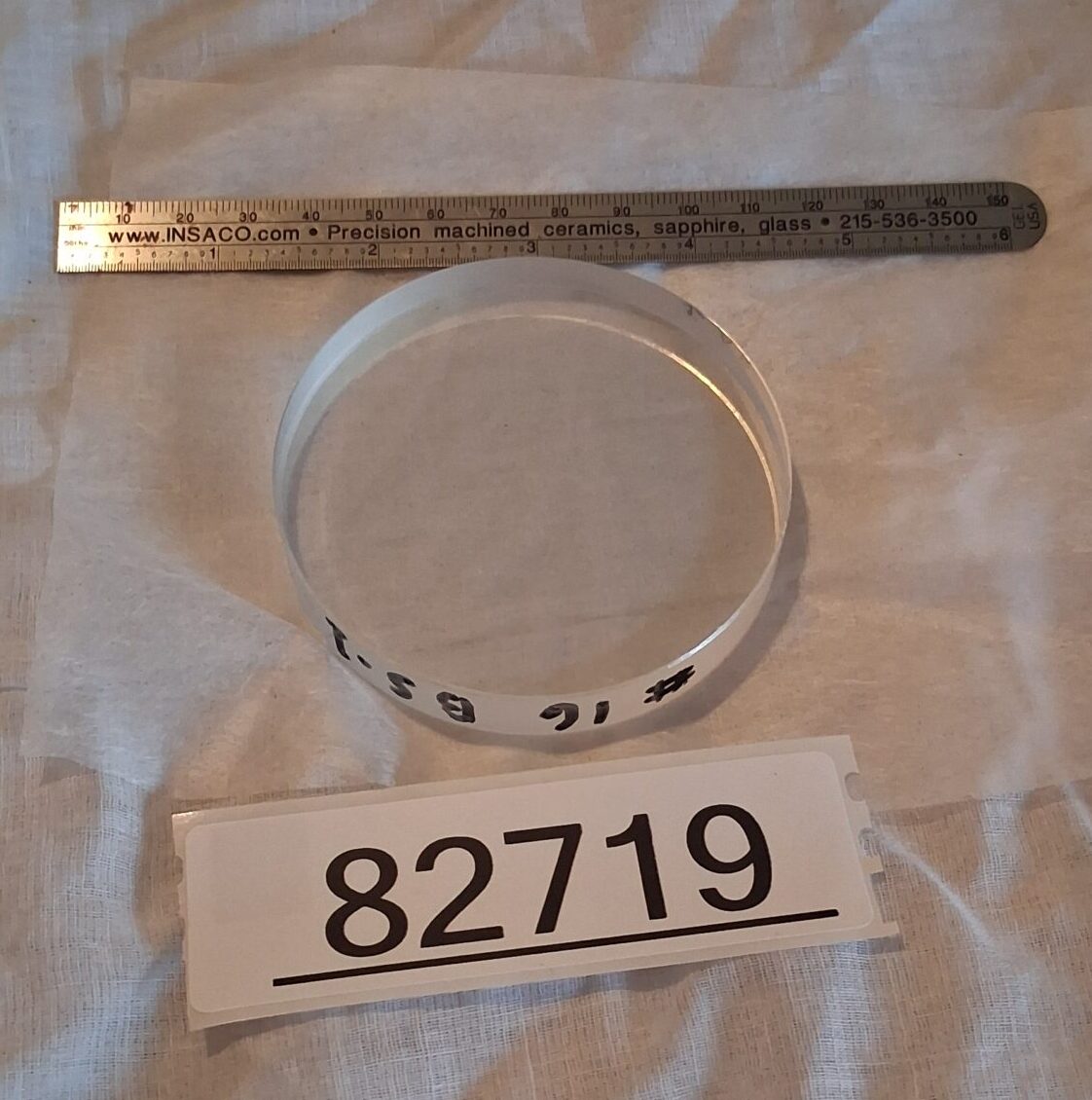
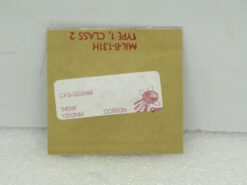
75mm Diameter 50/50 Plate Beam Splitter – Non-Polarizing, Dielectric Coated (Research-Grade Surplus)
This is a high-performance, non-polarizing plate beam splitter sourced from defense laboratory surplus. Built on a precision N-BK7 substrate with dielectric partial-reflective and anti-reflection (AR) coatings, it delivers reliable 50/50 splitting with minimal absorption and scatter for demanding visible to near-IR applications.
Key Specifications:
-
Type: Plate Beam Splitter (Non-Polarizing)
-
Split Ratio: 50% Reflection / 50% Transmission (at 45° incidence)
-
Diameter: 75 mm
-
Thickness: 13 mm (enhanced stability, reduced ghosting)
-
Substrate: N-BK7 Borosilicate Crown Glass (high homogeneity, low dispersion)
-
Coatings:
-
Partial-Reflective Dielectric Coating (one side)
-
Broadband Anti-Reflection (AR) Coating (opposite side – marked with “AR” arrow)
-
-
Wavelength Range: Optimized for Visible to Near-IR (~400–700 nm)
-
Incidence Angle: 45° (standard)
Condition:
✅ RESEARCH-GRADE SURPLUS – OPTICAL SURFACE PRISTINE
⚠ MECHANICAL: Minor edge nick outside clear aperture – does not affect performance
📐 ARROW MARKING: Clear “AR” indicator for correct orientation
Why This Beam Splitter Is a Superior Value:
-
Lab Provenance: Designed for defense/laser applications, ensuring precision and durability.
-
Robust Construction: 13mm thickness provides superior thermal and mechanical stability compared to thinner commercial optics.
-
Performance-Optimized: Dielectric coatings offer higher damage threshold and better spectral control than metallic coatings.
Applications:
-
Laser Systems: Beam splitting for alignment, power monitoring, or dual-path experiments (HeNe, diode, Argon lasers)
-
Interferometry: Core component in Michelson or Mach-Zehnder interferometers for precision metrology
-
Microscopy & Imaging: Beam combination for overlay imaging, holography, or augmented reality setups
-
Spectroscopy: Splitting light for reference/sample channels in Vis/NIR spectrometers
-
Education & Prototyping: Ideal for advanced optics courses, DIY telescopes, or optical demonstration benches
| Weight | 3 lbs |
|---|---|
| Dimensions | 8 × 6 × 4 in |
Related products

Optical Accessories


Optical Accessories
Fiber Tap Data Com 10/100/1000-Tap Passive Optical Connectors

Optical Equipment


Counters and Timers