
Product Description
Rare High-Precision Asymmetric Aspheric Biconvex Corrector Lens – 100 mm Diameter (US Defense Laboratory WFOV Program)
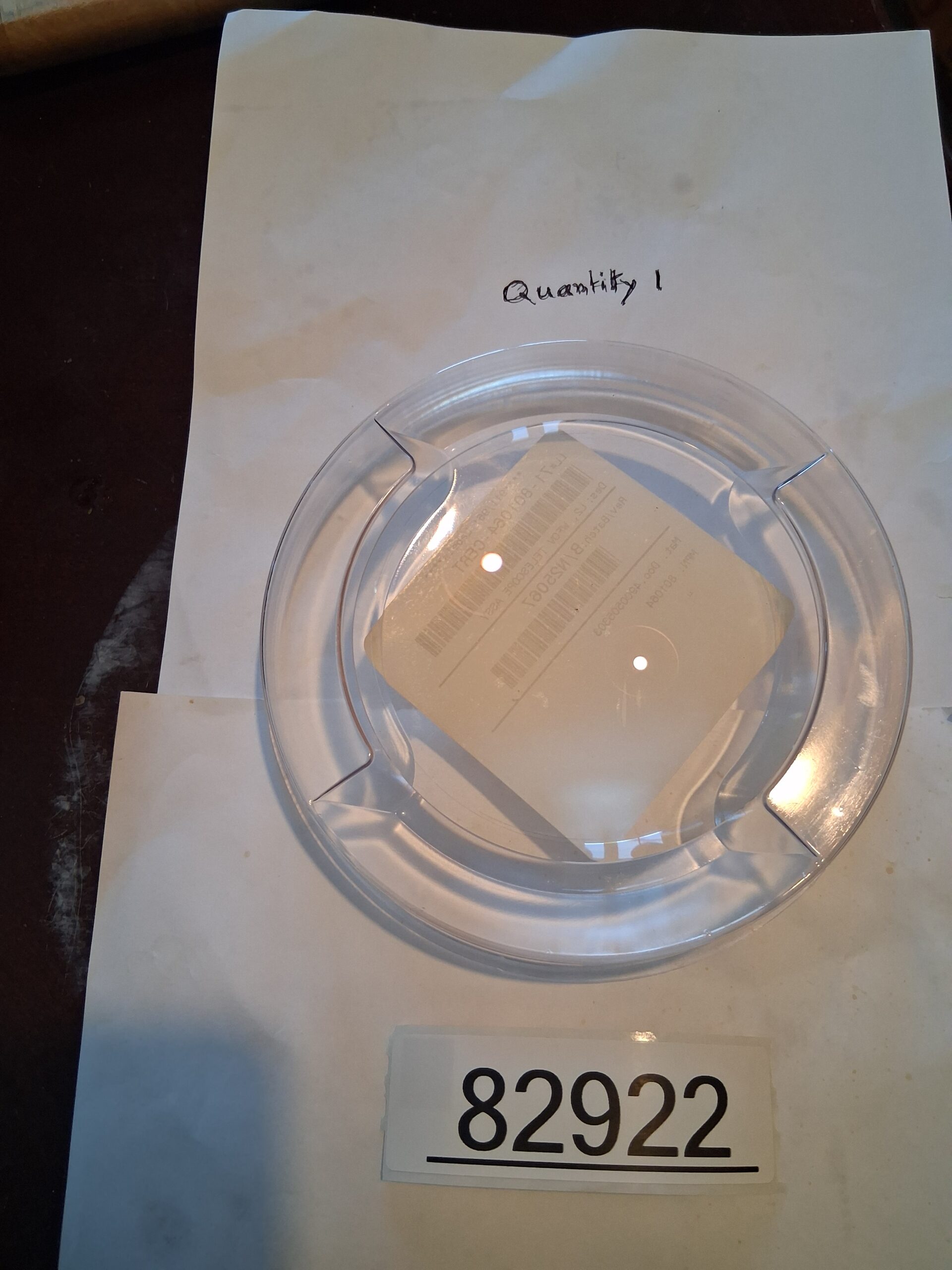
This is an extraordinary, custom-engineered asymmetric aspheric biconvex lens fabricated from high-purity fused silica for a U.S. Defense Laboratory Wide Field of View (WFOV) Telescope Assembly. Originally manufactured by Optimax Systems and coated by Barr Associates, this lens served as the L2 corrector/relay element in an advanced electro-optical surveillance system. With its precision aspheric figuring, dual-side broadband anti-reflective (BBAR) coatings, and documented provenance, it represents a pinnacle of optical engineering—offered here at a fraction of its original development cost.
Key Specifications:
-
Diameter: 100 mm (clear aperture ~92 mm)
-
Material: High-purity fused silica (ultra-low thermal expansion, exceptional homogeneity)
-
Figure: Asymmetric biconvex aspheric – varying curvatures for wide-field aberration correction
-
Thickness: Center ~15–20 mm; edges ~3.5 mm (lightweight design)
-
Coatings: Dual-side multilayer dielectric BBAR (>99% transmission per surface, visible/near-IR optimized)
-
Surface Quality: Precision polished to λ/10–λ/20+ with aspheric terms
-
Packaging: “CONTROLLED LEVEL 1 PART” – factory-sealed cleanroom packaging, pristine condition
-
Provenance: Traceable serial/rev numbers linking to U.S. defense WFOV program (circa 2010–2011)
Why This Lens Is Exceptional:
-
Defense-Grade Aspheric Precision: Combines complex surface figuring with broadband coating optimization for high-stakes imaging.
-
Ready-to-Integrate Condition: Preserved in original controlled packaging, surfaces flawless.
Applications:
-
Advanced Astronomical Imaging: Ideal as a field flattener/corrector in wide-field refractors or catadioptric telescopes for deep-sky, asteroid, or satellite tracking.
-
Surveillance & Space Situational Awareness: Directly suited to wide-field tracking, debris monitoring, or remote sensing systems.
-
High-Performance Laser Systems: Collimation, focusing, or beam expansion in visible/near-IR laser setups.
-
Optical Research & Education: Wavefront correction demonstrations, adaptive optics testing, or multi-element system prototyping in university or corporate labs.
-
Machine Vision & Remote Sensing: High-transmission, low-aberration imaging for drones, robotics, or environmental monitoring.
| Weight | 4 lbs |
|---|---|
| Dimensions | 10 × 10 × 10 in |
Related products

Optical Components


Optical Components
mixture of Hoya and Schott shortpass and bandpass filters- case of 20 mixed filters

Optical Components

Optical Components