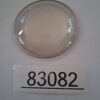

Product Description
Premium Polarization-Optimized Zinc Selenide (ZnSe) Output Coupler for CO₂ Laser Systems
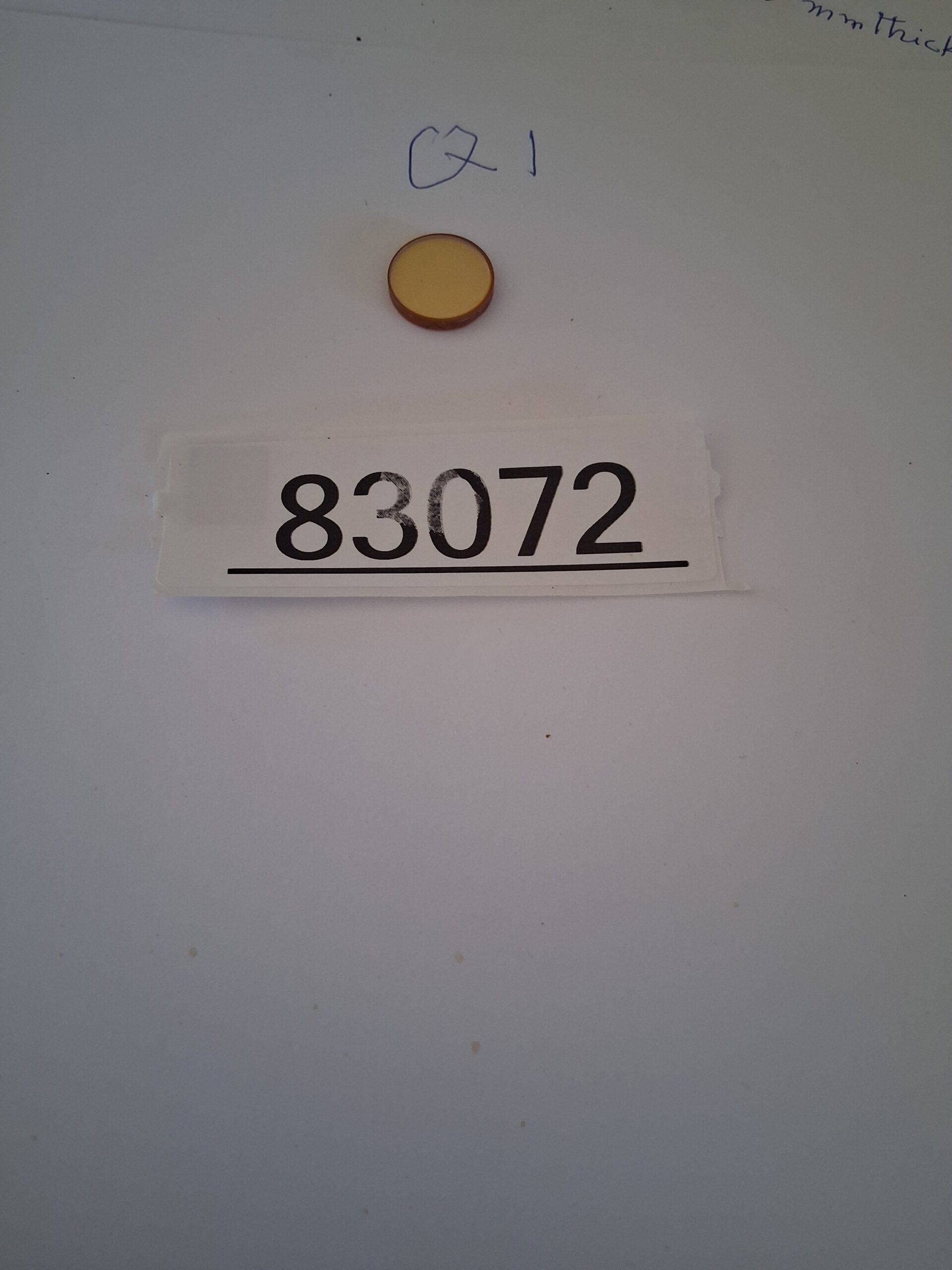
Boost your CO₂ laser efficiency with this specialized Zinc Selenide (ZnSe) output coupler, engineered for p-polarized operation at 10.6 µm wavelength. With dimensions of approximately 19 mm diameter (0.75″ equivalent) and 3 mm thick, this plano-plano optic boasts a partial reflectivity of 95% ±2% for p-polarized light (Rp) , enabling ~5% transmission.
Ideal as a resonator mirror, it reflects most light back into the cavity to maintain lasing while delivering a clean, polarized output beam externally. The polarization-specific coating (denoted “RP” on the edge) enhances compatibility with systems using Brewster windows or other polarization-sensitive elements, minimizing reflections and improving overall beam quality—a premium feature not found in standard unpolarized couplers.
Made from high-grade polycrystalline ZnSe for superior mid-IR transmission (0.6–22 µm) and low absorption, it features the material’s signature yellow-orange hue. A surface pointer ensures correct installation, with the high-reflectivity (HR) side facing the cavity and the anti-reflective (AR) side for beam extraction. This surplus item is in top condition, offering new-like performance at a fraction of the cost.
Key Specifications
| Specification | Details |
|---|---|
| Material | Laser-grade Zinc Selenide (ZnSe) – polycrystalline, CVD-grown |
| Dimensions | 19 mm diameter (0.75″ equivalent) x 3 mm thick |
| Shape | Plano-plano (flat on both sides) |
| Wavelength | Optimized for 10.6 µm (CO₂ lasers) |
| Reflectivity | 95% ±2% Rp (p-polarized light) |
| Polarization | Optimized for p-polarized light – ideal for Brewster window-equipped systems |
| Coating (Side 1) | Partial reflector with Rp = 95% @10.6µm |
| Coating (Side 2) | Standard high-efficiency low-loss anti-reflectance (AR) coating |
| AR Performance | <0.20% reflectance per surface @ 10.6µm (typical) |
| Transmission | >99.0% with AR coating |
| Surface Quality | 40/20 scratch-dig standard for reliable infrared use |
| Parallelism | < 3 arc minutes typical |
| Markings | “RP” edge marking for polarization orientation; surface pointer for correct installation |
| Condition | Surplus, excellent, fully operational |
Why Polarization-Optimized Matters
Most standard output couplers are designed for unpolarized or random-polarization operation. This optic is specifically engineered for p-polarized light, offering critical advantages:
-
Brewster Window Compatibility: Perfect for CO₂ laser cavities that use Brewster windows to produce linearly polarized output .
-
Reduced Losses: Optimized for p-polarization at 10.6µm minimizes reflection losses at interfaces.
-
Improved Beam Quality: Better polarization control leads to more stable mode structure and consistent output.
-
Enhanced Efficiency: Maximizes energy extraction from the gain medium while delivering a clean, polarized beam.
The “RP” edge marking confirms its polarization-specific design – a rare and valuable feature in surplus optics.
Technical Context: Output Coupler Function
In CO₂ laser resonators, the output coupler (front mirror) is designed to :
-
Reflect a portion of the beam (in this case 95%) back into the resonator for continuous amplification
-
Transmit a portion (~5%) of the beam for use as the laser output
The reflectivity directly influences output power, mode stability, and overall efficiency . At 95% reflectivity, this coupler is optimized for higher-gain CO₂ laser systems where only a small fraction of the intracavity power is extracted.
For ZnSe output couplers, standard reflectance tolerances are typically ±1.5% for 90-95% values . This unit’s ±2% tolerance remains within industry norms.
Material Advantages – Laser-Grade Zinc Selenide
ZnSe is a preferred material for output couplers due to its low absorptivity at infrared wavelengths and its visible transmission :
-
Low Absorption: <0.0005 cm⁻¹ at 10.6 µm – critical for high-power applications
-
Broad Transmission: 0.6–22 µm, covering visible to far-IR
-
Visible Transmission: Enables alignment with HeNe lasers (632.8 nm) – a major practical advantage
-
Non-Hygroscopic: Unlike some IR materials, ZnSe does not absorb moisture, ensuring long-term stability
-
High Thermal Stability: Excellent resistance to thermal shock
For high-power applications, it’s critical that the material bulk absorption and internal defect structure be carefully controlled, that minimum-damage polishing technology be employed, and the highest quality optical thin-film coatings are used . This II‑VI-grade optic meets all these criteria.
Applications
Industrial Precision:
-
Enhanced cutting, engraving, and welding on reflective materials like metals, where polarization control reduces back-reflections and improves cut quality
-
Compatible with laser systems from brands like Epilog, Trotec, and Universal
Medical Devices:
-
Surgical lasers and dermatology tools benefiting from stable, polarized beams for accurate tissue interaction
-
Suitable for Nd:YAG/CO₂ combination systems requiring polarization control
Research & Development:
-
Spectroscopy, IR imaging, and custom laser builds requiring fine-tuned resonator optics
-
Experimental setups exploring coherent coupling of waveguide lasers
Aerospace/Defense:
-
High-power testing and processing with minimized optical losses
-
Polarization-sensitive beam delivery systems
Custom Laser Systems:
-
Ideal for engineers building or upgrading CO₂ lasers with Brewster window cavities
-
Replacement or upgrade for OEM output couplers
Condition
EXCELLENT SURPLUS CONDITION
OPTICAL SURFACES: CLEAN, COATINGS INTACT
EDGE MARKINGS: “RP” CLEARLY LEGIBLE
SURFACE POINTER PRESENT FOR CORRECT INSTALLATION
STORED AND HANDLED WITH CARE
READY FOR IMMEDIATE INTEGRATION
⚠ CRITICAL HANDLING NOTE: ZnSe is a soft, brittle crystal material . Always wear gloves when handling. Handle only by edges. Never use tools or tweezers. Apply uniform pressure when mounting. Clean only with approved optical solvents and lint-free cloths if absolutely necessary. ZnSe is toxic – wash hands after handling .
| Weight | 1 lbs |
|---|---|
| Dimensions | 6 × 3 × 3 in |
Related products


Counters and Timers