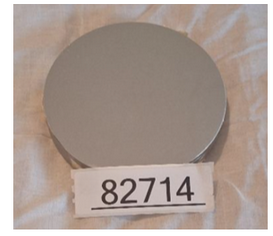
Rare Vintage Spex Industries Pristine 125mm Fused Silica Concave Spherical Mirror
$1,200.00
1 in stock
CompareWhat sets this apart from off-the-shelf optics is its Spex heritage. The fused silica substrate provides elite performance: It withstands extreme temperatures without warping (coefficient of thermal expansion near zero), resists chemical degradation, and handles high-energy beams better than glass alternatives—making it “future-proof” for high-power or harsh environments. At 125 mm diameter, it’s larger than typical hobby mirrors yet compact for integration, with the 19 mm thickness ensuring durability without excess weight. In an era of mass-produced imports, this is a one-of-a-kind American-made artifact blending historical value with practical excellence, potentially from projects tied to academic or government labs.
Key Specifications
• Diameter: 125 mm (≈5 inches)
• Focal Length: 0.75 m (750 mm), yielding a moderate f/6 ratio for balanced performance in focusing or imaging applications
• Radius of Curvature: 1495 mm (measured)
• Edge Thickness: 19 mm (provides superior structural integrity and thermal stability for demanding uses)
• Material: Fused silica substrate (high-purity amorphous silicon dioxide glass), offering unmatched thermal resistance, low expansion, and high laser damage threshold—far superior to standard BK7 glass
• Coating: Dielectric multilayer design optimized for high reflectivity in the UV-visible-near-IR spectrum
Applications and Uses
This mirror’s spherical profile and fused silica construction make it versatile across scientific, educational, and creative fields:
• Spectroscopy and Laser Systems: Perfect for focusing or collimating beams in Raman, fluorescence, or absorption spectrometers; also ideal for laser experiments (e.g., Nd:YAG or diode lasers) where high damage thresholds prevent coating failure under moderate power.
• Astronomy and Custom Telescopes: Serves as a primary mirror in a Newtonian reflector or compact Cassegrain setup, delivering sharp images for stargazing or planetary observation. The f/6 ratio strikes a great balance between light-gathering power and manageable aberrations.
• Optical Research and Education: Excellent for lab demos in interferometry, holography, or photonics courses at universities/makerspaces. Its precision figuring ensures low scatter and high efficiency in beam manipulation.
• Industrial and DIY Projects: Use in photography (as a telephoto condenser), microscopy enhancements, or even artistic light installations requiring controlled reflection.
• Collectors’ Item: A tangible piece of optics history from Spex, which influenced advancements in analytical chemistry and physics—appeals to enthusiasts of vintage scientific gear.
| Weight | 4 lbs |
|---|---|
| Dimensions | 8 × 6 × 4 in |
Related products

Optical Components



Optical Components

Filters Iris Diaphragms and Slits
Thorlabs NE10A-B AR-Coated Absorptive Neutral Density Filter